The Watchfulness Burden: How Perpetual Fear Is Costing Immigrant Families Their Health, Wealth, and Future
There is a kind of exhaustion that does not come from physical labor. It settles into the body slowly, born not from long hours or heavy lifting, but from the relentless mental work of staying alert — scanning surroundings, rehearsing responses, calculating risk in situations most Americans navigate without a second thought. For a substantial portion of the immigrant population living in the United States today, this vigilance is not occasional. It is constant. And it carries a price that rarely appears in any economic ledger.
At Jan Kalyan Parishad, our work places us in close proximity to families navigating exactly this reality. What we observe — and what a growing body of research confirms — is that the invisible tax of perpetual watchfulness is one of the most consequential and least discussed barriers to community well-being in America.
What Researchers Mean by "Perpetual Vigilance"
Psychologists who study immigrant populations use the term "hypervigilance" to describe a state in which individuals remain continuously alert to potential threats. Originally applied to trauma survivors, the concept has gained traction in immigration research as scholars document how enforcement uncertainty — the fear of detention, deportation, or family separation — produces measurable neurological and physiological stress responses.
A landmark study published in the American Journal of Public Health found that Latino adults living in states with aggressive immigration enforcement policies reported significantly elevated rates of anxiety, depression, and poor sleep quality compared to peers in less restrictive environments. Critically, these effects were not limited to undocumented individuals. U.S. citizens living in mixed-status households — including American-born children — showed similar patterns of psychological strain.
This is the architecture of the invisible tax: it spreads across households, across generations, and across documentation statuses. It does not discriminate by legal standing.
The Financial Dimension: When Fear Becomes an Economic Barrier
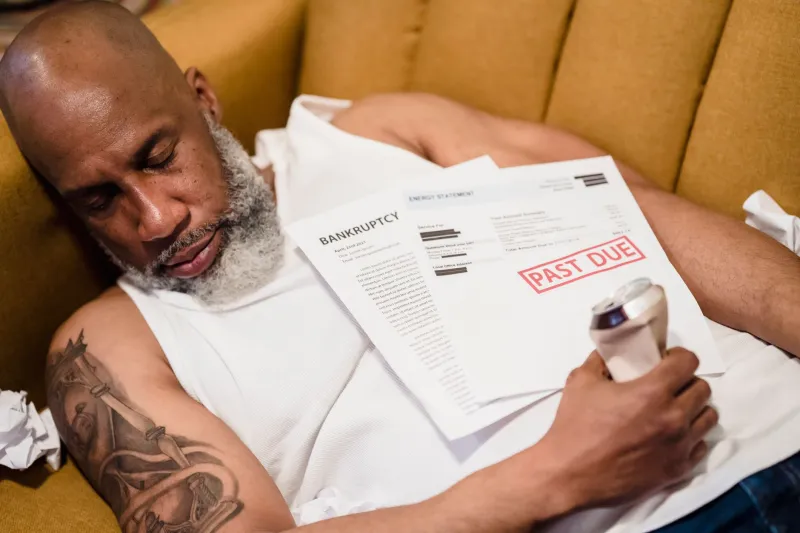
The connection between psychological stress and financial outcomes is well-established in social science literature. What is less frequently discussed is how immigration-specific fear creates its own distinct economic drag.
Consider the decisions that families under constant vigilance routinely make. They may avoid opening bank accounts, fearing that financial institutions could become conduits for enforcement. They may decline employer-sponsored benefits or workplace protections, unwilling to draw attention to their documentation status. They may forego medical appointments, skip legal consultations, or avoid community programs they would otherwise be eligible for — not because these services are inaccessible, but because accessing them feels dangerous.
Each of these decisions, individually rational given the circumstances, compounds into a pattern of economic self-restriction that limits earning potential, suppresses asset accumulation, and widens the wealth gap between immigrant households and the broader population. A family that avoids a free health screening because the clinic is near a government building is not being irrational. They are being prudent in a system that has given them reason to be afraid. But prudence, in this context, has a measurable cost.
Researchers at the UCLA Latino Policy and Politics Institute estimate that fear-driven avoidance of public services costs immigrant communities hundreds of millions of dollars annually in foregone benefits and untreated health conditions — resources that were legally available and deliberately left unclaimed.
Children Bear a Disproportionate Share of the Weight
Perhaps the most troubling dimension of this invisible tax is its impact on the youngest members of affected households. Children in mixed-status families frequently report absorbing their parents' anxiety, developing their own heightened sensitivity to news coverage, law enforcement presence, and changes in family routine.
Educators working in communities with large immigrant populations describe students who arrive at school distracted, sleep-deprived, or emotionally withdrawn following periods of heightened enforcement activity in their neighborhoods. Academic performance suffers. Social development is disrupted. The long-term consequences for educational attainment and future economic mobility are significant.
These children are, in many cases, American citizens. The invisible tax does not spare them simply because their birth certificates say otherwise.
Community Networks as a Counterweight
Amid these pressures, community organizations across the United States have developed creative, resilient structures designed to reduce the burden of vigilance without requiring families to assume additional risk.
Know-your-rights workshops, conducted in community spaces rather than government buildings, equip families with accurate legal information that reduces the anxiety of operating in ignorance. Rapid-response networks — coordinated through text chains, community liaisons, and trusted local institutions — allow neighborhoods to alert one another to enforcement activity, creating a layer of communal protection that no individual family could sustain alone.
Mental health programs specifically designed for immigrant populations have expanded in cities like Chicago, Los Angeles, Houston, and New York, offering culturally competent counseling through community health workers who speak participants' languages and understand their specific fears. These programs do not simply treat symptoms; they work to restore a sense of agency and safety that chronic vigilance systematically erodes.
Financial empowerment initiatives, meanwhile, are addressing the economic dimension of the problem by creating pathways to banking, credit-building, and asset accumulation that do not require documentation that many families cannot safely provide. Community development financial institutions and credit unions serving immigrant populations have pioneered products specifically designed to meet families where they are, rather than where the conventional financial system assumes they should be.
The Policy Dimension: Reducing Uncertainty at Scale
Community-level interventions, while essential, cannot fully substitute for policy environments that reduce the underlying sources of legal uncertainty. Advocates working in this space consistently identify a cluster of policy reforms with the potential to meaningfully lower the invisible tax.
Expanded access to legal representation in immigration proceedings — currently unavailable to the vast majority of respondents who cannot afford private counsel — would reduce the proportion of individuals navigating the system without adequate guidance. Sanctuary policies at the municipal and county level, which limit the extent to which local law enforcement participates in federal immigration enforcement, have been associated in multiple studies with improved health outcomes and greater civic engagement among immigrant populations.
Pathways to regularization — legal mechanisms that allow long-term residents to normalize their status — address the root cause of perpetual vigilance more directly than any other intervention. The evidence from countries and jurisdictions that have implemented such pathways consistently shows improvements in labor market participation, tax revenue, and community investment following legalization.
Toward Communities Where Everyone Can Breathe
The invisible tax is not inevitable. It is the product of specific policy choices, enforcement priorities, and institutional structures — and it can be reduced through deliberate action at every level of society, from the neighborhood mutual aid network to the halls of Congress.
At Jan Kalyan Parishad, our commitment to community wellness encompasses every member of the communities we serve, regardless of documentation status or national origin. We believe that no family should spend its energy and resources simply on the act of surviving scrutiny. That energy belongs to children's education, to neighborhood investment, to the kind of civic participation that strengthens the social fabric for everyone.
The work of lifting this burden is, at its core, the work of building communities where human dignity is not contingent on paperwork — where every resident can direct their attention toward flourishing rather than fear. That work is ongoing. And it is among the most important commitments we can make to the future of American community life.